Natural stone has been valued for centuries for its beauty, durability and individuality. But creating a premium natural stone project takes more than selecting the right slab.
Whether it’s luxury residential fixtures, commercial fit-outs or public spaces, projects that continue to perform and look exceptional for decades are defined by decisions made long before the stone is installed.
For architects, specifiers, fabricators and installers, these decisions influence both the finished appearance and long-term performance of the project.
Here are five choices that can make or break the final result.

1. Protect natural stone slabs from cracking and breakage
Veins, fissures and natural variations give every slab its unique character. They can also create vulnerable areas, particularly in thinner slabs or around sink and cooktop cut-outs.
Rather than treating these characteristics as defects, experienced fabricators reinforce them before they become a problem on the bridge saw or during handling.
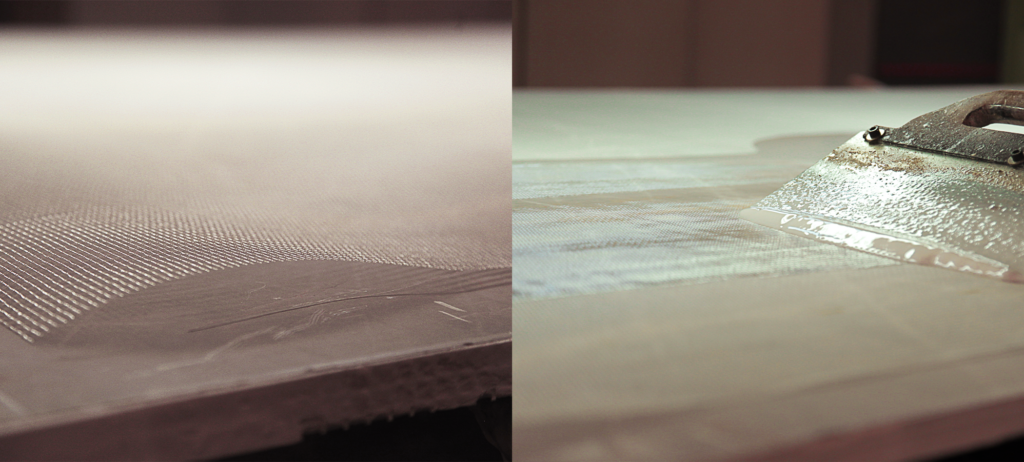
Extra‑low‑viscosity epoxy resins such as Megapoxy HX can penetrate fine cracks and fissures to strengthen the stone from within, while fibreglass mesh lamination bonded with Megapoxy H or HX provides additional support during handling and installation. Reinforcing these areas early helps improve durability, reduce waste and maximise the usable yield from every slab.
Key takeaway: Identify fissures, cut-outs and brittle areas before machining. Reinforce them first with a penetrating resin and fibreglass mesh, before they lead to damage during machining, handling or transport.
2. Create seamless natural stone joins with the right epoxy
A premium stone project should showcase the stone, not the joins.
Visible glue lines, poor colour matching or joints that move over time can undermine even the highest‑quality material. Achieving a seamless finish relies on careful preparation, precise fabrication and selecting an epoxy that suits the stone, the joint geometry and the working conditions.
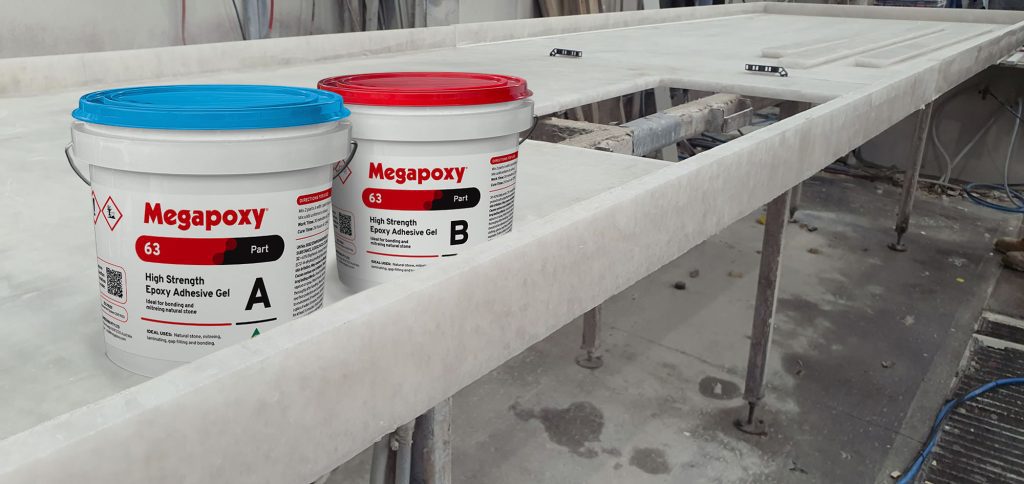
The right epoxy choice helps keep joins strong and discreet so the natural stone remains the focus. Megapoxy 63 and Megapoxy 69 are both suited to benchtops, mitres and intricate stonework, offering strong bonds, clean glue lines and colour-tinting options. Megapoxy 63 is particularly useful where a very thin, translucent glue line and resistance to yellowing are priorities, while Megapoxy 69 offers non-sag performance, exceptional impact resistance and a longer working time for larger or more demanding assemblies.
Key takeaway: Choose the epoxy to suit the join, the stone and the project. Consider translucency and colour-matching requirements, glue-line thickness, bond strength and the fabrication method. For visible joins, test the finished colour on an offcut first.

3. Mitres and edges deserve special attention
Modern stone design continues to push the limits of what’s possible. Thin benchtops, waterfall ends, floating vanities and oversized stone panels all rely on precisely fabricated mitres and edge build-ups to achieve their clean, architectural appearance.
However, these details can place significant stress on a relatively small bonding area. If there is too little stone-to-stone contact, the mitre can become the weak point.
A strong result depends on three things: enough bonding area, full adhesive coverage and accurate alignment. The epoxy should suit a tight joint, stay in place during assembly and allow the pieces to be positioned precisely.
Megapoxy 63 is well suited to this work. Its non-sag consistency supports vertical and angled application, while its ability to form a thin glue line helps create crisp, closely aligned mitres and edge build-ups. Gitani Stone used this approach in manufacturing a premium marble benchtop.
Key takeaway: Don’t rely on a razor-thin stone edge alone for strength. Design enough bonding area into the mitre and use an epoxy suited to tight, precise joints.
4. Choose the best fixing system for natural stone facades and cladding
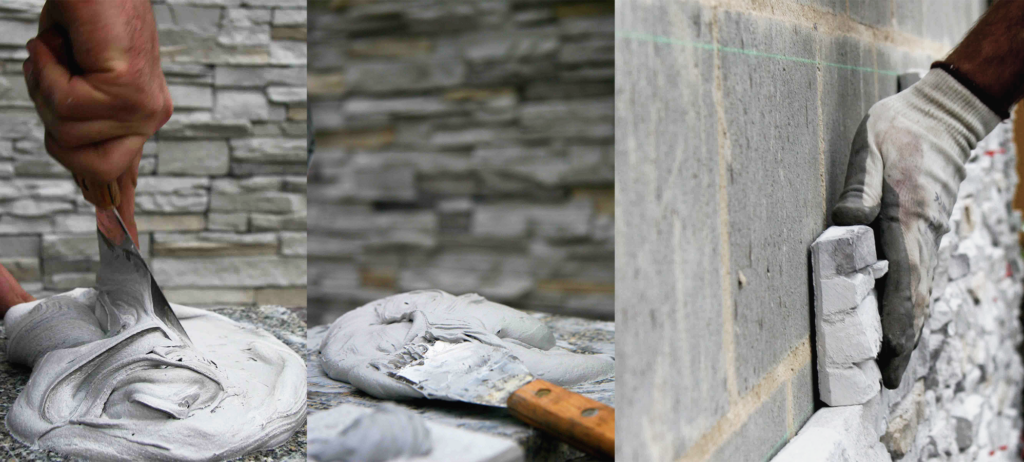
The most impressive stone facade or feature wall only performs as well as the system behind it. Panel size, substrate condition, environmental exposure and structural requirements all influence the appropriate fixing method. Some applications are suited to adhesive bonding alone, while others need engineered mechanical fixings working alongside structural epoxy adhesives to manage wind loads and long‑term movement.
Considering these requirements early helps reduce installation challenges and gives specifiers more confidence in long-term performance.
Megapoxy supports a range of natural stone fixing methods, including spot-fixing systems using Megapoxy PM and Megapoxy PF, full-bed bonding with Megabond, and a compatible waterproof membrane and adhesive system using Megapoxy H for suitable waterproofed wall applications.
Key takeaway: Confirm panel weight, substrate condition, cavity depth, design wind loads and whether mechanical fixings are required before finalising the detail. These factors determine whether spot fixing, full‑bed bonding or a combined mechanical and epoxy system is appropriate.
5. Get mixing and working time right for stone installation
Even a high‑performance epoxy will only deliver its full strength if it is mixed and applied correctly.
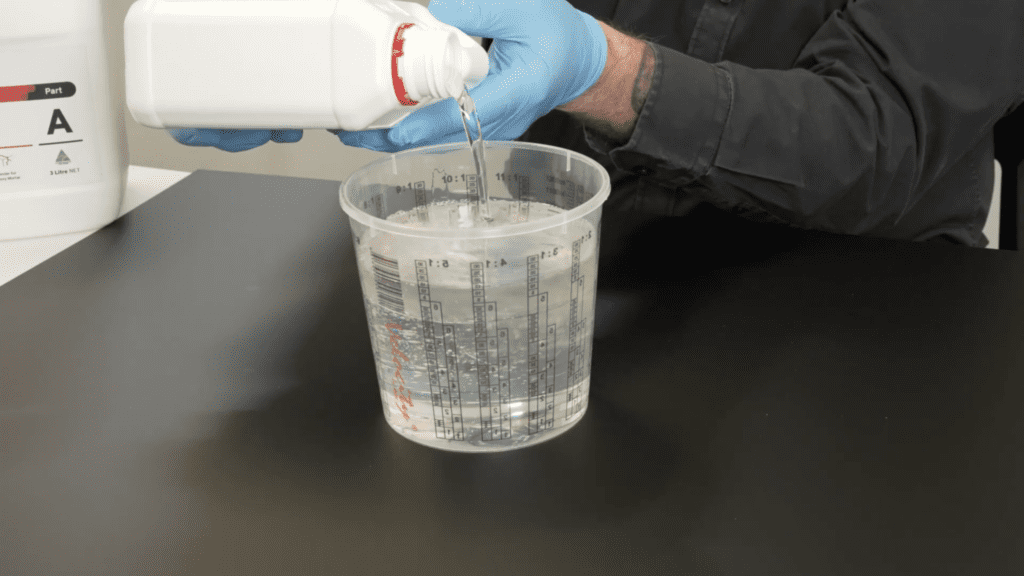
The correct ratio matters. Inaccurate measuring or incomplete mixing can reduce bond strength, prevent a full cure and lead to discolouration over time. Pastes and gels should be blended until completely uniform, while clear liquid resins should be mixed carefully without whipping to minimise trapped air.
Working time also needs to suit the task. Detailed mitres, edge build‑ups and larger stone elements may need enough time for accurate alignment and adjustment, while rapid repairs or onsite fixes can benefit from rapid‑set systems such as Megapoxy PF, which sets within minutes. Temperature and batch size also affect how much usable working time is available.
Key takeaway: Follow the specified mix ratio and mixing method, and choose an epoxy working time that suits the scale and complexity of the task.
For more than 50 years, Megapoxy has helped fabricators, installers and specifiers achieve stronger, longer‑lasting natural stone projects through high‑performance epoxy solutions and practical technical support.
Explore our Natural Stone solutions, download the Natural Stone Products Guide, or read our Quarry to Lobby article to see specific Megapoxy systems mapped to each stage of the process.
Need advice? Find your closest distributor or contact us anytime.