A practical guide to specifying epoxy flooring systems that improve durability and extend service life.
Industrial and commercial floors operate under increasing load and performance demands – driven by e-commerce, automation, 24/7 operations and stricter regulations.
Standard concrete and low-grade coatings often fail under constant weight and traffic – leading to cracking, dusting and costly repairs. In many cases, the issue is not the coating itself, but how the system has been specified and built from the substrate up.
High-performance epoxy systems provide a more robust approach – forming a bonded, seamless surface that withstands mechanical load and chemical exposure over time.
A properly specified epoxy flooring system can significantly extend service life, reducing downtime and the need for frequent resurfacing.
Environments that demand high‑performance epoxy flooring
- Manufacturing and industrial plants: Continuous production, heavy machinery and material handling place constant stress on floor surfaces. Epoxy systems help withstand localised loads, impact and exposure to oils, coolants and cleaning chemicals, for lasting performance.
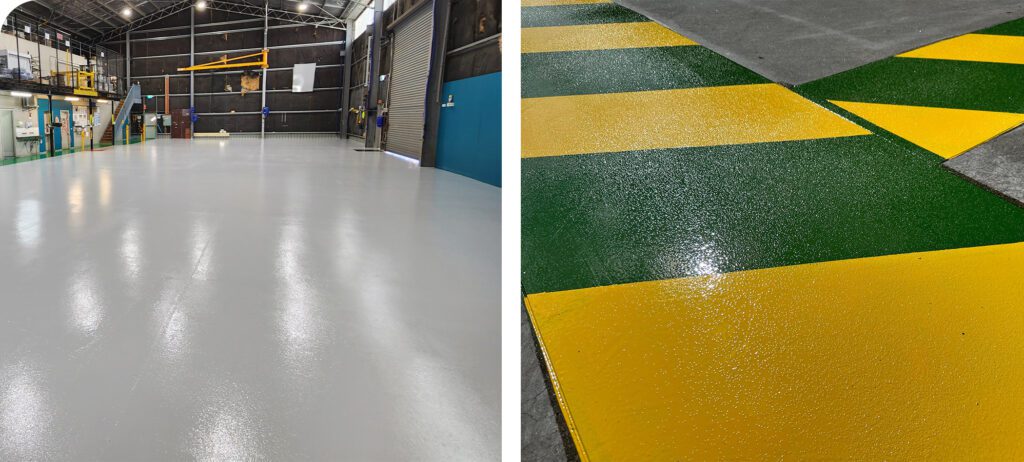
- Warehouses and logistics hubs: Movement of forklifts and pallet jacks can wear and break down untreated concrete, creating dust and safety issues. High-build epoxy coatings improve wear resistance, control dust and allow clear marking of traffic lanes and loading zones.
- Aviation and aerospace: Hangar floors are required to support high loads while resisting aviation fuels and hydraulic fluids, without degradation or staining.
- Defence facilities and vehicle bays: Workshop and storage floors must handle heavy vehicles, resist impact and abrasion, and tolerate fuels, lubricants and decontamination chemicals.
- Pharmaceutical and chemical facilities: Floors must perform under heavy equipment while resisting aggressive chemicals, and remain seamless and easy to clean to meet strict operational and safety requirements.
- Food processing and commercial kitchens: Floors are exposed to heavy equipment, regular washdowns and spills. Systems must be safe for food environments, potable water exposure, and finished with slip-resistant aggregates where required.
The right epoxy flooring system – from the slab up
Every project is different. Substrate condition, moisture, traffic type and chemical exposure all influence the right system design.
In most cases, creating heavy-duty flooring isn’t about a single product. It’s a compatible epoxy system from repair through to final coating.
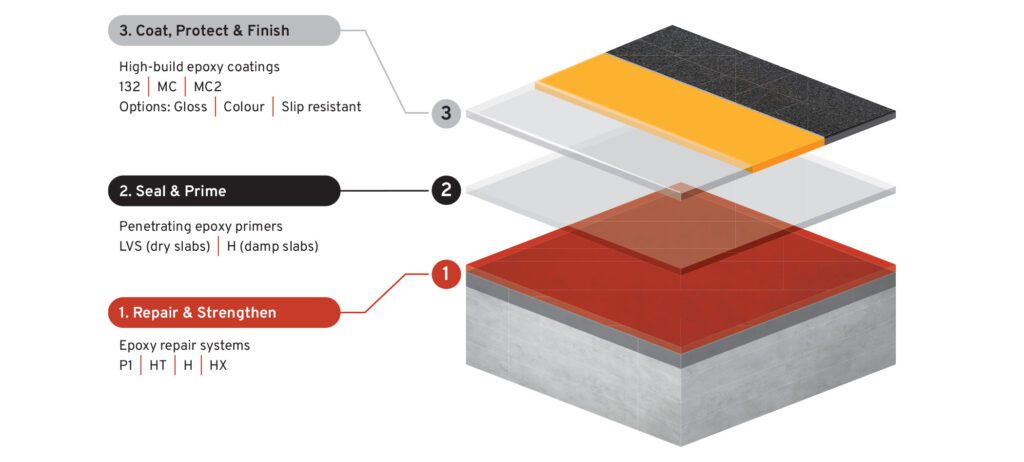
- Repair and strengthen: start with the substrate
Cracked or deteriorated concrete weakens the system and leads to ongoing repair. Epoxy adhesive repair solutions restore strength before coating begins, so the system is built on a stable, reinforced base – not just covering underlying defects. Paste and gel adhesives like Megapoxy P1 and HT suit shallow and wider cracks, while flowable resins such as Megapoxy H and HX penetrate finer cracks.
- Seal and prime
Once the substrate is sound, penetrating formulations like Megapoxy LVS seal porous concrete, control absorption and improve adhesion for subsequent layers. Where slabs are damp, Megapoxy H can be used as a primer.
- Coat, protect and finish
High-build coatings like Megapoxy 132, MC and MC2 provide long-term surface protection. They form a durable layer matched to load, traffic and exposure conditions, and are available in gloss finishes that lift light levels and give a polished, professional look. Systems can also be pigmented with colour and finished with slip-resistant aggregates.
Surface preparation, mixing and application are critical to performance.
Specifying for performance – not just product
Many flooring failures can be traced back to early specification decisions: where systems are selected without fully considering substrate condition, load and exposure. High-performing floors are not defined by a single product, but by how the entire system is designed.
- The condition and preparation of the substrate.
- The selection of primers suited to moisture and porosity.
- The build and thickness of coatings matched to traffic, load and conditions.
- The ability of the system to withstand chemical exposure, cleaning regimes and slip requirements.
By taking a system-based approach, specifiers and project teams can reduce risk, improve durability and ensure the floor performs as intended over the long term.
Need to match the right epoxy flooring system to your environment? Download our Quick-reference Specifier Guide today. For more advice and support, use our Solution Selector, contact us or find your closest distributor.